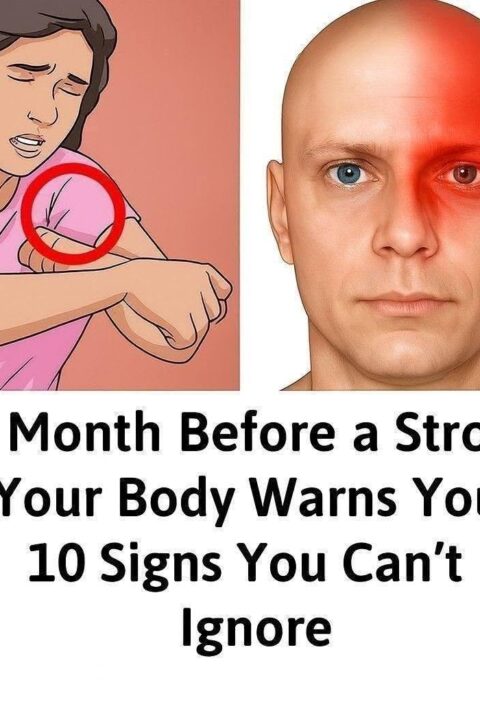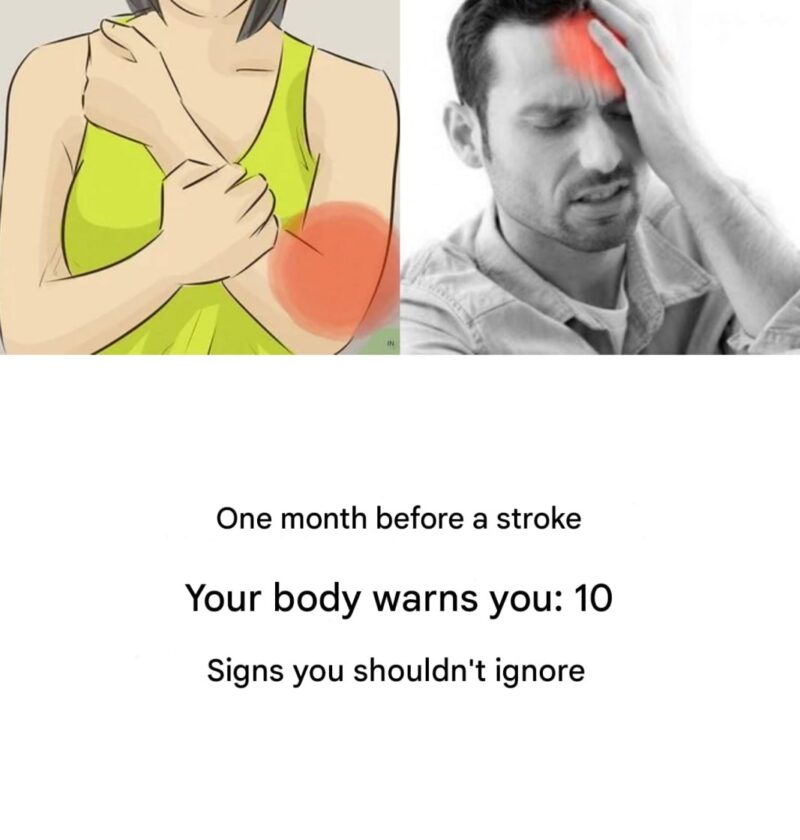
The idea that your body “definitely warns you one month before a stroke” is misleading. Some people do experience early warning symptoms, but they are usually days, weeks, or months in advance in a small number of cases, and more commonly they happen suddenly within minutes to hours.
The most important true “warning event” is a mini-stroke (TIA – Transient Ischemic Attack), which can happen days or weeks before a major stroke and should never be ignored.
Here are 10 warning signs and risk signals that may indicate an increased stroke risk or an impending TIA/stroke:
1. Sudden weakness or numbness (especially one side)
Weakness in the face, arm, or leg—often on just one side of the body.
2. Slurred speech or trouble speaking
Words become unclear, or you struggle to form sentences.
3. Sudden vision problems
Blurred vision, double vision, or temporary loss of vision in one eye.
4. Severe unexplained headache
A sudden, intense headache unlike your usual pattern (more common in hemorrhagic stroke).
5. Dizziness or loss of balance
Trouble walking, coordination issues, or feeling like you might fall.
6. Temporary confusion or memory issues
Sudden difficulty understanding simple things or getting confused.
7. Tingling or “pins and needles” on one side
Especially if it comes on suddenly without a clear cause.
8. Brief episodes of vision or speech loss (TIA warning)
Symptoms last minutes to hours and then disappear completely.
9. Sudden fatigue or feeling “off”
Some people report unusual exhaustion or feeling unwell before neurological symptoms.
10. Risk-factor warning signs (silent danger)
Not symptoms, but important signals:
- High blood pressure
- Diabetes
- Smoking
- High cholesterol
- Irregular heartbeat (especially atrial fibrillation)
Important reality check
- A stroke is often sudden, not gradually predictable.
- The closest real “early warning” is a TIA (mini-stroke).
- About 1 in 3 people who have a TIA may later have a stroke if untreated.
When to act immediately
Use the FAST test:
- Face drooping
- Arm weakness
- Speech difficulty
- Time to call emergency help immediately
If you want, I can also explain:
- How to tell TIA vs stroke vs migraine
- Early prevention steps based on your age and risk
- Or what to do in the first 10 minutes if symptoms appear