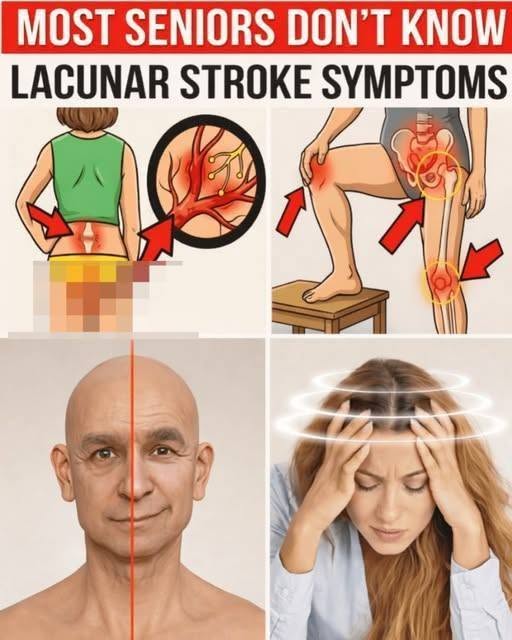
That title is another clickbait-style warning. It sounds urgent, but it mixes real stroke symptoms with exaggeration and “fear framing.” There is no special set of “7 overlooked signs” unique to lacunar stroke that applies only to people over 60.
A lacunar stroke is a small-vessel stroke affecting deep parts of the brain. It’s a subtype of stroke under stroke, and its symptoms depend on which area is affected.
Here are real, medically recognized warning signs of stroke (including lacunar stroke patterns):
🚨 1) Sudden weakness or numbness (face, arm, or leg)
Often on one side of the body.
This is one of the most common signs.
🗣️ 2) Speech problems
- Slurred speech
- Trouble finding words
- Difficulty understanding others
👁️ 3) Vision changes
- Sudden loss of vision in one eye
- Blurred or double vision
🚶 4) Balance or coordination problems
- Sudden dizziness
- Difficulty walking
- Loss of coordination
(This is often what clickbait posts highlight as “especially #4,” but it’s not unique to lacunar stroke—it’s a general stroke symptom.)
🧠 5) Confusion or cognitive changes
- Sudden disorientation
- Trouble thinking clearly
⚡ 6) Sudden severe headache (more common in other stroke types)
Not always present in lacunar strokes, but important in general stroke warning signs.
😶 7) Subtle “mini-stroke” episodes (TIAs)
Short-lived symptoms that resolve within minutes or hours:
- Weakness
- Speech difficulty
- Vision issues
These can be warning signs of a future full stroke.
🧠 Key reality check
- Lacunar strokes are often small but serious
- They are strongly linked to risk factors like hypertension and diabetes
- Symptoms can be subtle, but they still follow the same general stroke pattern
🚨 When to act immediately
Use the FAST rule:
- Face drooping
- Arm weakness
- Speech difficulty
- Time to call emergency services
Bottom line
There is no secret hidden list of “7 overlooked signs.” Stroke symptoms are well-established, and the safest approach is simple:
Any sudden neurological change = treat as an emergency.
If you want, I can break down how lacunar strokes differ from other strokes in a very simple way.