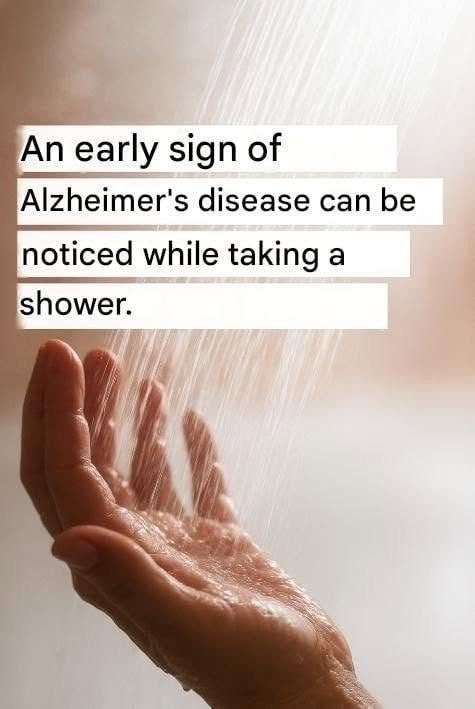
That statement is partly based on real observations, but it’s also a bit misleading if taken literally.
Alzheimer’s disease can affect the brain in ways that show up in very everyday routines—including bathing—but there is no single “shower-only” early sign that confirms the disease.
What the statement is trying to refer to
In early Alzheimer’s (and other dementias), people may develop difficulty with complex, multi-step daily tasks, and showering is one of them because it requires:
- Remembering the sequence (undress → adjust water → wash → rinse → dry)
- Judging water temperature safely
- Keeping track of time
- Managing multiple steps without getting confused
So the “shower sign” usually refers to apraxia or executive dysfunction, such as:
- Forgetting steps mid-shower
- Standing confused about what to do next
- Needing repeated instructions for basic hygiene
- Avoiding bathing due to confusion or anxiety
Why it’s not a reliable “early sign”
Problems in the shower can happen for many other reasons, including:
- Normal aging and slower thinking
- Depression or low motivation
- Arthritis or physical pain
- Vision problems
- Medication side effects
- Stress or fatigue
So it cannot be used alone to suspect Alzheimer’s disease.
More recognized early warning signs
Clinicians usually look for a pattern of symptoms, such as:
- Frequent memory loss (especially recent events)
- Repeating questions or stories
- Getting lost in familiar places
- Trouble handling money or planning tasks
- Word-finding difficulties in conversation
- Noticeable changes in judgment or personality
Bottom line
The shower example is a real-life illustration of how dementia can affect daily functioning, but it is not a specific or early diagnostic sign by itself.
If you want, I can break down:
- Early vs late Alzheimer’s symptoms
- How to differentiate normal aging from dementia
- Or warning signs families often miss at home