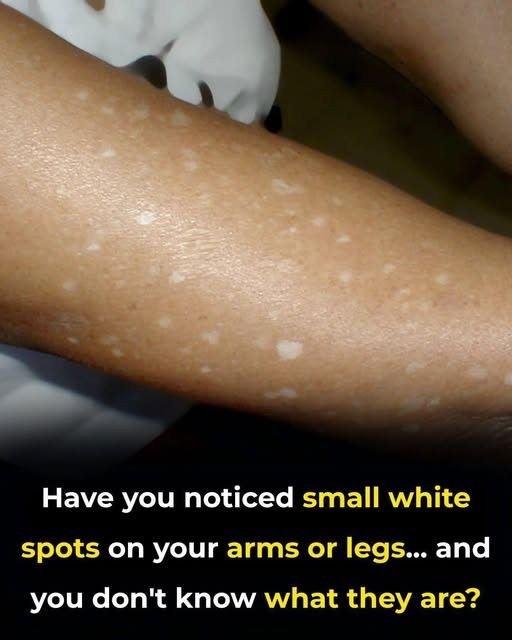
Small white spots on the arms and legs are fairly common, and they can come from several different causes. Most are harmless, but the appearance and pattern can help narrow down what’s going on.
Here are the main possibilities you should know about:
1) Idiopathic guttate hypomelanosis (very common)
These are tiny, flat white “confetti-like” spots, usually on sun-exposed areas like forearms and shins.
- More common with age and sun exposure
- Completely harmless
- Often called “sun spots” (but lighter, not darker)
- No treatment needed unless for cosmetic reasons
2) Tinea versicolor (fungal infection)
A yeast overgrowth on the skin that causes uneven light or dark patches.
- Can appear as small pale spots that slowly merge
- Often on chest, back, shoulders, but can spread to arms
- Mild scaling or fine “dust-like” texture may be present
- More noticeable after sun exposure
- Treatable with antifungal creams or shampoos
3) Vitiligo (autoimmune)
This causes smooth, well-defined white patches due to loss of pigment.
- Spots are usually “milky white” and clearly bordered
- Can grow or spread over time
- Often affects hands, arms, face, and joints
- Not painful or itchy
- Needs medical evaluation for confirmation and management
4) Pityriasis alba (common in children/teens)
A mild eczema-related condition.
- Light, slightly dry or scaly patches
- Common on cheeks, arms, and legs
- More visible after sun exposure
- Usually fades with moisturizers and time
5) Keratosis pilaris (often confused with white spots)
This is more of a “texture” issue than true pigment loss.
- Small rough bumps, sometimes pale or skin-colored
- Common on upper arms and thighs
- Often feels like “sandpaper skin”
- Harmless and very common
When you should get checked
See a dermatologist if:
- Spots are spreading quickly
- They become sharply white or symmetrical
- You notice hair turning white in those areas
- There’s itching, scaling, or inflammation
- You’re unsure which pattern fits your skin changes
Simple self-check tips
- Flat + powdery scale → more likely fungal (tinea versicolor)
- Sharp milky-white patches → possible vitiligo
- Small age/sun spots → IGH
- Dry light patches in kids → pityriasis alba
If you want, you can describe your spots (size, itchiness, how long they’ve been there, whether they’re spreading), and I can help narrow it down further.