That claim is another classic gardening exaggeration.
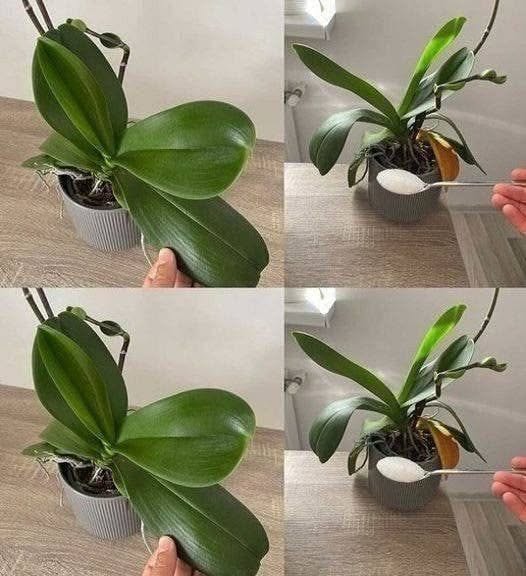
Orchids don’t bloom continuously just because of “one tablespoon” of some fertilizer. Their blooming cycle is controlled by light, temperature changes, root health, and proper feeding balance, not a single magical dose.
What’s likely behind the claim
These posts usually refer to homemade “miracle” fertilizers such as:
- rice water
- banana peel water
- milk water
- Epsom salt (magnesium sulfate)
- diluted sugar solutions
- commercial orchid fertilizers (NPK mixes)
Some of these can help slightly, especially if a plant is nutrient-deficient, but none guarantee continuous flowering.
What orchids actually need to bloom
For most common orchids like Phalaenopsis orchid:
1. Proper light (most important)
- Bright, indirect light
- Too little light = leaves grow but no flowers
2. Temperature difference
- A small day/night temperature drop often triggers flowering
3. Correct watering
- Overwatering is one of the biggest reasons orchids fail
- Roots should dry slightly between watering
4. Balanced fertilizer
- A diluted orchid fertilizer (like 20-20-20 or bloom formulas)
- Usually used weakly (quarter strength) every 1–2 weeks during growth
5. Rest period
- Orchids naturally take breaks between bloom cycles
- They do NOT flower continuously year-round
The reality about “one tablespoon”
Even if a fertilizer is useful:
- dose depends on product concentration, plant size, and watering schedule
- “one tablespoon” is not a universal safe or effective amount
- overfeeding can burn orchid roots and stop blooming entirely
Bottom line
No single spoonful of any ingredient will make orchids bloom endlessly. Healthy orchids bloom when their environment is stable and balanced, not because of a one-time miracle feed.
If you want, tell me what orchid you have and I can give you a simple blooming schedule that actually works.