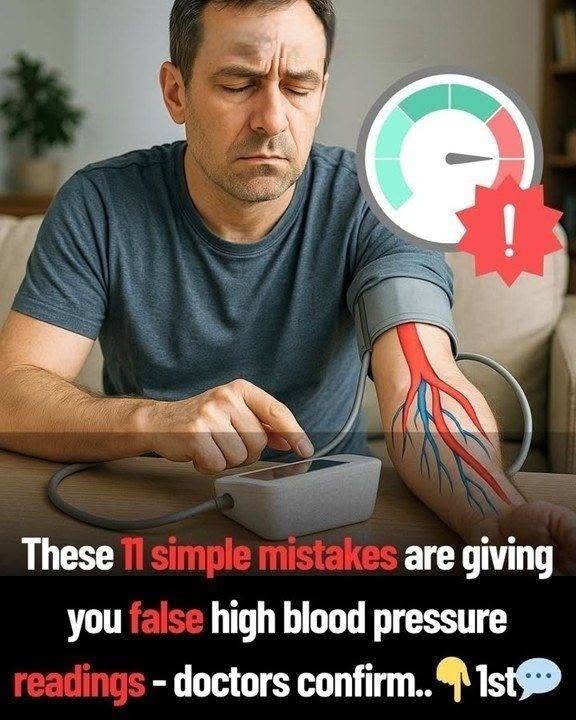
Why Your Blood Pressure Reading Might Be Wrong (Doctor-Explained Guide)
Understanding Blood Pressure Readings
Hypertension is diagnosed based on repeated measurements of blood pressure over time. However, doctors often warn that a single reading—especially if taken incorrectly—can be misleading.
Many people panic when they see a high number on the monitor, but in reality, small mistakes during measurement can easily create falsely high readings.
This is why accurate technique matters just as much as the machine itself.
Why False High Readings Happen
Blood pressure is sensitive to:
- Body position
- Stress level
- Recent activity
- Environment
- Measurement technique
Even small errors can temporarily raise readings by 10–40 mmHg, leading to unnecessary worry or incorrect diagnosis.
Doctors emphasize that proper technique is essential before concluding someone has hypertension.
11 Common Mistakes That Can Fake High Blood Pressure Readings
1. Talking during measurement
Speaking raises blood pressure slightly and affects accuracy.
2. Not resting before checking
If you measure immediately after walking, stress, or activity, readings may be higher than normal.
3. Caffeine or smoking before testing
Tea, coffee, energy drinks, or cigarettes within 30 minutes can temporarily increase blood pressure.
4. Full bladder
A full bladder can raise readings significantly without you realizing it.
5. Wrong arm position
If your arm is:
- Hanging down → reading increases
- Too high → reading decreases
Ideal position is at heart level.
6. Incorrect cuff size
- Small cuff → falsely high readings
- Large cuff → falsely low readings
Proper fit is crucial for accuracy.
7. Tight clothing under cuff
Rolling sleeves too tight or placing cuff over thick clothing can distort results.
8. Legs crossed during reading
Crossing legs increases pressure and can artificially raise readings.
9. Back not supported
Sitting without back support causes muscle tension, affecting results.
10. Not taking multiple readings
A single reading can be misleading. Doctors usually recommend:
- 2–3 readings
- Average them for accuracy
11. Stress or anxiety (“white coat effect”)
Some people feel nervous while measuring blood pressure, causing temporary spikes.
This is known as the white coat effect, where anxiety alone increases readings.
How Doctors Recommend Checking Blood Pressure Correctly
To get accurate results:
- Sit quietly for 5 minutes before measuring
- Keep feet flat on the ground
- Support your back and arm
- Place cuff on bare upper arm
- Avoid caffeine/exercise 30 minutes before
- Take 2–3 readings and average them
Why This Matters
Incorrect readings can lead to:
- Unnecessary medication
- Anxiety and stress
- Misdiagnosis of hypertension
- Missed detection of real blood pressure issues
That’s why doctors always recommend confirming readings over multiple days.
PART 1 SUMMARY
Many everyday habits—like talking, stress, wrong posture, or incorrect cuff use—can falsely raise blood pressure readings. Proper technique is essential before diagnosing Hypertension.
PART 2: Simple Step-by-Step Guide (Easy Version)
How to Avoid False Blood Pressure Readings
Step 1: Rest first
Sit quietly for 5 minutes.
Step 2: Avoid triggers
No coffee, smoking, or exercise before checking.
Step 3: Sit correctly
Back supported, feet flat, legs uncrossed.
Step 4: Position arm properly
Keep arm at heart level.
Step 5: Use correct cuff
Make sure it fits your arm size.
Step 6: Stay silent
Do not talk during measurement.
Step 7: Repeat readings
Take 2–3 readings and calculate the average.