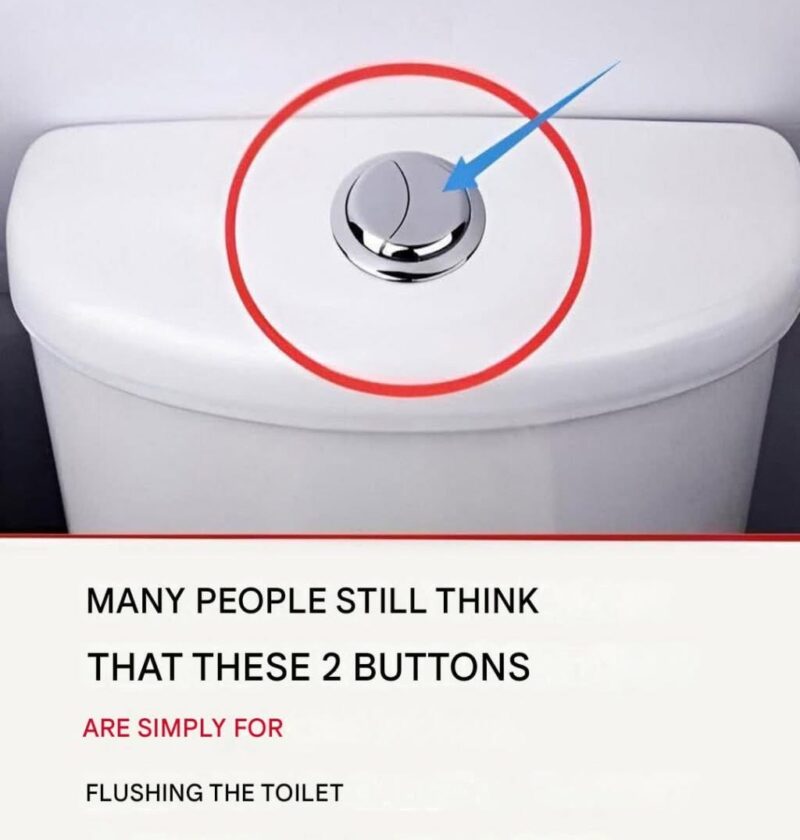
Those two buttons you see on modern toilets are part of a dual-flush system, and the idea behind them is actually about saving water, not just “flushing harder or softer.”
What the two buttons really do
Most dual-flush toilets have:
- Smaller button (half flush)
Used for liquid waste (urine)
It releases a smaller amount of water, usually around 3–4.5 liters - Larger button (full flush)
Used for solid waste
It releases more water, usually around 6–9 liters
The difference is controlled by the internal valve mechanism, which determines how much water is released from the tank.
Why this system exists
Traditional toilets used the same amount of water every time, whether you needed it or not. That led to a lot of waste.
Dual-flush systems were designed to:
- Reduce household water usage
- Lower water bills
- Help conserve freshwater resources
In fact, compared to older single-flush toilets, dual-flush models can save thousands of liters of water per year per household.
Common misunderstanding
Many people think:
- “Both buttons just flush the toilet differently”
- Or “one is stronger, one is weaker”
But the real purpose is choosing how much water is needed, not just flushing strength.
Some people also press both buttons together (thinking it “flushes better”), but that usually just wastes more water or doesn’t improve performance.
How it works inside (simple version)
Inside the tank there’s a valve system:
- The half flush button opens the valve partially or for a shorter time
- The full flush button opens it fully or longer
This controls how much water rushes into the bowl.
Why it matters
Water scarcity is a serious issue in many parts of the world, so this small design change has a big environmental impact when millions of homes use it correctly.
If you want, I can also explain why some toilets flush weakly even with the full button, or how to fix common dual-flush problems.