Why Your Jeans Get Those Weird Ripples … And How to Fix Them
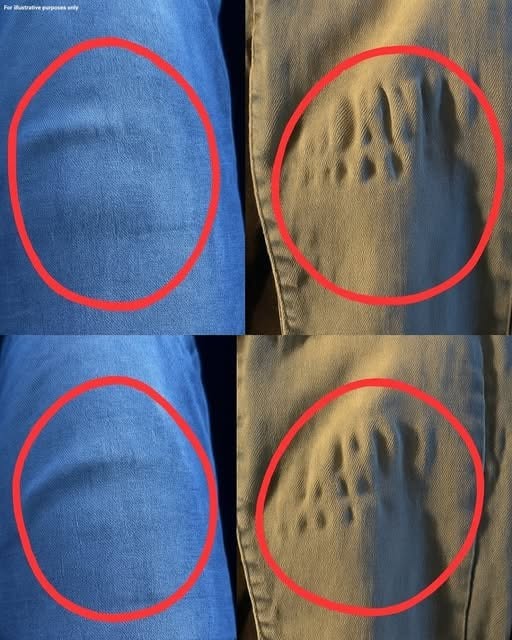
Those wavy lines, twists, or “ripples” that develop in jeans are usually not a sign that you’re wearing them wrong. They’re often caused by a combination of fabric behavior, manufacturing, and washing habits.
Common causes of jean ripples
1. Fabric twisting (leg twist)
Denim is made from woven cotton fibers. After repeated washing and drying, the fabric can gradually twist, causing seams to shift and creating rippled or spiraled legs.
2. Shrinkage from heat
High dryer temperatures can cause uneven shrinking, leading to puckering around seams and wrinkles that don’t hang straight.
3. Stretch denim fatigue
Many modern jeans contain elastane (spandex). Over time, repeated stretching and washing can cause uneven tension in the fabric, resulting in ripples around the thighs, knees, or hips.
4. Poor fit
Jeans that are too tight in certain areas may develop persistent creases and ripples because the fabric is constantly under stress.
5. Manufacturing factors
Lower-cost denim sometimes isn’t “sanforized” (pre-shrunk) as effectively, making it more prone to twisting and puckering after washing.
How to fix or reduce ripples
Wash in cold water
Cold water helps reduce shrinkage and fabric distortion.
Turn jeans inside out
This helps protect the outer fabric and reduces wear.
Avoid overdrying
Remove jeans while slightly damp and let them finish air-drying.
Reshape while damp
Smooth seams and gently pull the fabric back into shape before drying completely.
Use a steamer or iron
Light steaming can relax wrinkles and minor puckering.
Buy higher-quality denim
Well-constructed jeans with properly aligned grain and better-quality fabric tend to resist twisting and rippling longer.
When the ripples won’t go away
If the fabric itself has permanently twisted or the stretch fibers have worn out, there may be no complete fix. In that case, the ripples are a sign of fabric aging rather than