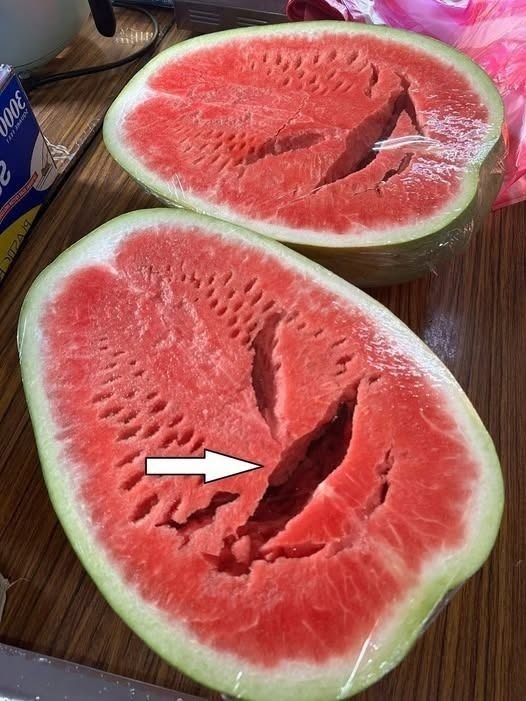
That’s another fear-based viral claim. Seeing cracks or unusual lines inside a watermelon does not automatically mean it’s dangerous.
The fruit in question is Watermelon.
🍉 What “cracks” inside watermelon usually mean
There are a few real, harmless explanations:
1) Natural internal cracking (growth stress)
- Happens when the fruit grows quickly
- Uneven water uptake or temperature changes
- Creates small splits or hollow-looking lines inside
👉 This is common in large, fast-growing watermelons.
2) Over-ripening
- Flesh becomes slightly separated or grainy
- Texture may look uneven or “broken”
- Taste is usually still safe, just less fresh
3) Variety differences
Some watermelon varieties naturally have:
- Fibrous streaks
- Irregular flesh patterns
- Less uniform texture
⚠️ When you SHOULD not eat it
Discard the watermelon if you notice:
- Sour or alcoholic smell
- Slimy or mushy texture
- Mold inside or outside
- Gas bubbles or foaming (fermentation)
- Bitter or off taste
These are signs of spoilage, not “cracks.”
🧠 Important reality check
- Internal cracks are usually a quality issue, not a safety issue
- Viral posts often confuse natural growth patterns with contamination
- Food safety depends on smell, texture, and taste, not appearance alone
🍉 Bottom line
Cracks inside a watermelon are usually harmless and caused by growth conditions or ripeness, not something dangerous.
If you want, I can show you how to pick a perfectly ripe watermelon before cutting it (simple tricks that actually work).