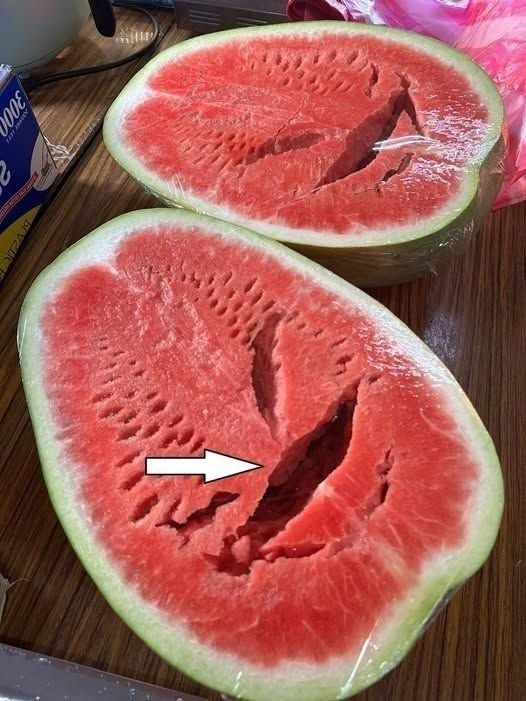
That claim is alarmist and misleading. Seeing cracks inside a watermelon is usually not an emergency warning, and it does not automatically mean the fruit is dangerous.
🍉 Why watermelons can have internal cracks
Internal cracking (sometimes called hollow heart or flesh separation) is usually caused by:
- Rapid growth of the fruit
- Irregular watering during development
- Temperature changes while growing
- Natural variation in how the fruit matures
It’s a plant growth issue, not a sign of poison or contamination.
❌ Does it mean you should stop eating it?
Not necessarily.
In most cases:
- The watermelon is still safe to eat
- The texture may just be mealy, dry, or less sweet
- The cracks are not bacteria or toxins
⚠️ When you should throw it away
You should not eat it if you notice:
- A sour or fermented smell
- Slimy texture
- Mold (white, green, or black spots)
- Bitter or “off” taste
- Signs it was left unrefrigerated too long after cutting
These indicate spoilage, not cracks alone.
🧠 Why these posts go viral
Headlines like this are designed to:
- Create fear (“stop eating immediately!”)
- Turn normal food variations into danger signals
- Drive clicks and shares
But food science does not support the idea that internal cracks alone make watermelon unsafe.
✔️ Bottom line
Cracks inside watermelon are usually just a natural growth defect, affecting texture—not safety. You only need to worry if there are clear signs of spoilage.
If you want, I can show you how to pick a perfectly ripe watermelon before cutting it open, so you avoid disappointing ones in the first place.