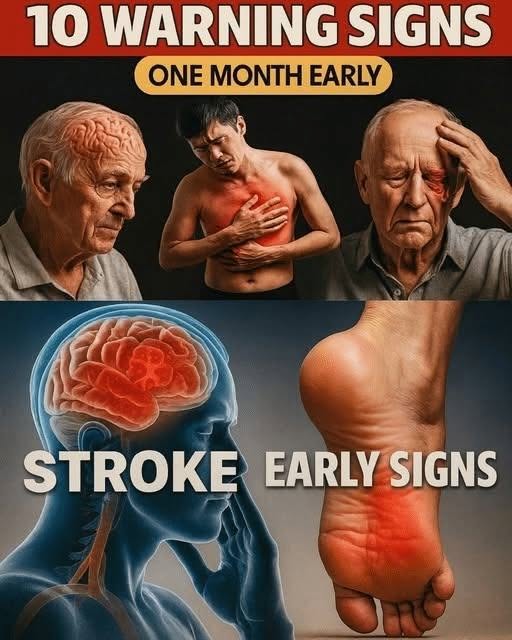
The idea that there are “10 warning signs of stroke one month before” is misleading. Most strokes do not give a clear 1-month warning. However, some people experience early warning events, especially transient ischemic attacks (TIAs), which can happen days, weeks, or sometimes a bit earlier before a major stroke.
🚨 First important truth
A stroke is usually sudden. But warning signs can include short episodes that should never be ignored.
⚠️ Possible early warning signs (not a fixed checklist or timeline)
1. Sudden numbness or weakness
- Face, arm, or leg (often one side)
2. Temporary speech problems
- Slurred speech or trouble finding words
3. Brief vision loss or blurring
- In one or both eyes
4. Sudden dizziness or balance issues
- Feeling unsteady, stumbling
5. Short episodes of confusion
- Difficulty understanding or thinking clearly
6. Severe sudden headache
- Especially unusual or “worst ever”
7. Tingling or loss of coordination
- Clumsiness in hand or arm
8. Brief facial drooping
- Even if it resolves quickly (important TIA sign)
9. Sudden difficulty walking
- Weak legs or loss of balance
10. Transient ischemic attack (TIA)
- Stroke-like symptoms that disappear within minutes to hours
- This is the strongest warning sign of future stroke
🧠 Key concept: TIA (“mini-stroke”)
A Transient Ischemic Attack happens when blood flow to the brain is briefly blocked.
- Symptoms resolve quickly
- But it is a major warning that a full stroke may follow
- Risk is highest in the first days to weeks after a TIA
⏱️ Important timing fact
- Some people have warning symptoms hours or days before
- Others have no warning at all
- There is no reliable “1-month symptom pattern”
🧍♂️ What to do if symptoms appear
Use FAST:
- Face drooping
- Arm weakness
- Speech difficulty
- Time to call emergency help immediately
Even if symptoms disappear → still urgent.
🧠 Bottom line
There is no guaranteed 10-symptom, 1-month warning system for stroke. The most important real warning is a TIA, which requires immediate medical attention to prevent a full stroke.
If you want, I can also explain how to tell stroke vs migraine vs anxiety, which is where many people get confused.