Pain can sometimes point to an organ, but it’s not a reliable one-to-one map because pain is influenced by nerves, muscles, inflammation, posture, and even stress.
Here’s a more accurate breakdown of what “where it hurts” can actually mean:
🧠 Why pain location is not a perfect “organ map”
- Nerves can “refer” pain to other areas (called referred pain)
- Muscles and joints often mimic organ pain
- Stress and anxiety can amplify or shift pain
- One organ can cause pain in multiple areas
📍 Common pain locations (and what they might mean)
🫀 Chest pain
Could be:
- Heart-related issues (pressure, tightness, radiating to arm/jaw)
- Acid reflux (burning, after eating)
- Muscle strain (worse with movement or pressing)
⚠️ Chest pain is always taken seriously because heart causes must be ruled out first.
🧠 Head
Could be:
- Tension headache (tight band feeling)
- Migraine (throbbing, nausea, light sensitivity)
- Dehydration or sleep issues
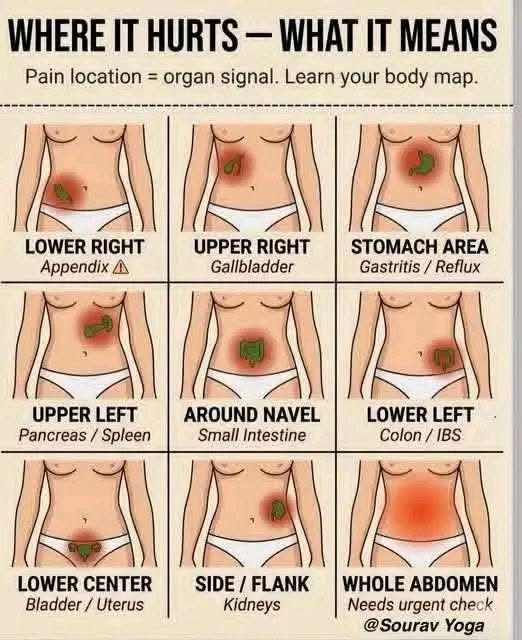
🟡 Upper right abdomen
Could involve:
- Liver or gallbladder issues (especially after fatty meals)
- Gas or indigestion
🔴 Lower right abdomen
Could include:
- Appendix inflammation (Appendicitis)
- Gas or bowel irritation
🟣 Lower left abdomen
Could include:
- Constipation
- Irritable bowel syndrome
- Colon inflammation
🦵 Back pain
Most commonly:
- Muscle strain (very common)
- Disc or nerve issues
- Poor posture
Less commonly:
- Kidney issues (deep, one-sided pain, sometimes with urinary symptoms)
⚠️ Important reality check
Pain is often:
- non-specific
- influenced by multiple systems
- not directly “organ = exact location”
So viral charts that claim precise mapping are not medically reliable.
🧠 Better rule to use
Instead of “where it hurts = organ,” doctors think:
- What triggers it?
- How does it feel (sharp, burning, dull)?
- What makes it better or worse?
- Any other symptoms (fever, nausea, weight loss, etc.)?
👍 Bottom line
Pain location can give clues, but it’s only one piece of the puzzle—not a diagnosis by itself.
If you want, you can tell me where your pain is and how it feels, and I’ll help you narrow down the most likely causes in a realistic way.