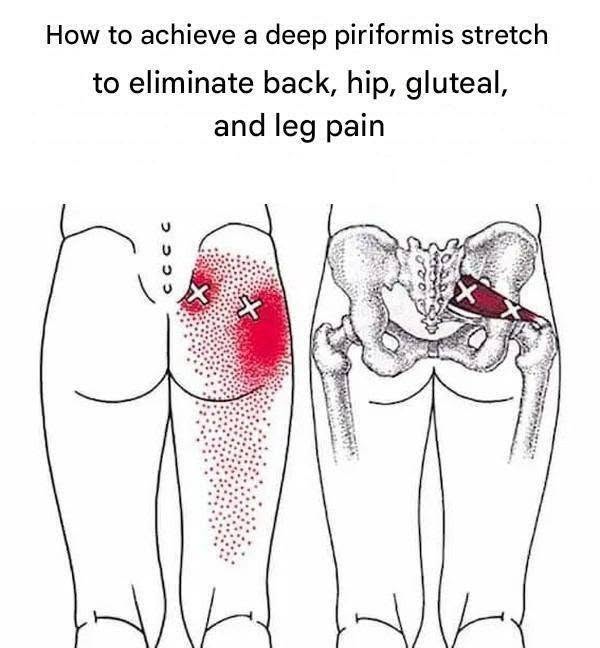
A “deep piriformis stretch” targets the piriformis muscle, which can contribute to tightness or irritation around the hip and sometimes compress the sciatic nerve, leading to pain in the buttock, hip, or down the leg (often discussed in relation to sciatica-like symptoms).
First, a key point: stretching can help if the issue is muscle tightness, but if pain is caused by a herniated disc, nerve compression, or true sciatica, stretching alone may not fully resolve it—and sometimes aggressive stretching can worsen symptoms.
Here are safe, commonly used deep piriformis stretches:
1. Figure-4 stretch (lying down)
- Lie on your back with knees bent.
- Cross one ankle over the opposite knee (forming a “4” shape).
- Pull the uncrossed leg gently toward your chest.
- You should feel a deep stretch in the glute of the crossed leg.
- Hold 20–30 seconds, repeat both sides.
2. Seated figure-4 stretch
- Sit upright in a chair.
- Place one ankle over the opposite knee.
- Lean forward with a straight back.
- This is gentler and good for daily use.
3. Pigeon pose (yoga-based stretch)
- Bring one leg forward bent at the knee, other leg extended back.
- Keep hips square and slowly lean forward.
- This provides a deeper stretch but should be done carefully.
4. Supine knee-to-opposite-shoulder stretch
- Lie on your back, pull one knee across your body toward the opposite shoulder.
- Focus on slow, controlled movement.
Helpful tips:
- Warm up first (light walking helps).
- Don’t force the stretch into sharp pain—only mild to moderate tension.
- Hold stretches, don’t bounce.
- Combine with gentle strengthening (glutes and core) for longer-term relief.
If your pain includes numbness, tingling, or weakness down the leg, it’s worth checking for nerve involvement such as sciatica or lumbar spine issues rather than only tight muscle.