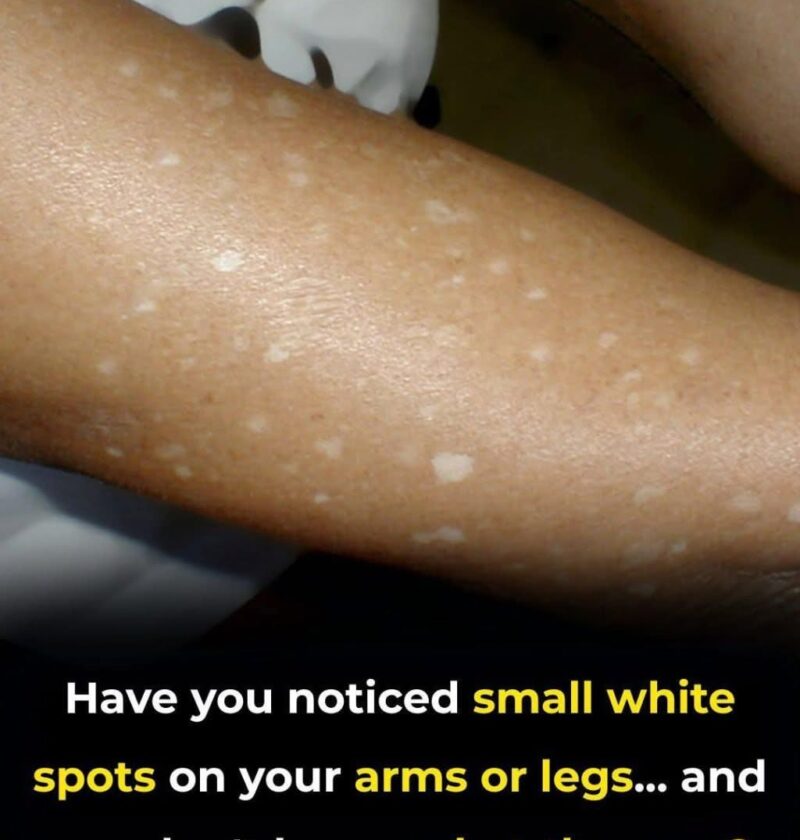
Small white spots on the arms or legs are fairly common, and they can have several different causes. A headline suggesting they always mean one particular condition is misleading.
Some possible explanations include:
- Idiopathic guttate hypomelanosis (IGH) – One of the most common causes in adults.
- Small, smooth, flat white spots, usually 2–5 mm across.
- Often appear on the forearms, shins, and other sun-exposed areas.
- More common with age and long-term sun exposure.
- Harmless and not contagious.
- Tinea versicolor
- A superficial yeast infection that can cause lighter (or darker) patches, usually on the chest, back, neck, or upper arms.
- The patches may have fine scaling and can be mildly itchy.
- It can usually be treated with antifungal medications.
- Vitiligo
- Causes well-defined patches of skin that lose pigment.
- The patches are often larger than IGH spots and may gradually spread.
- It’s an autoimmune condition and is not contagious.
- Post-inflammatory hypopigmentation
- Light spots can appear after eczema, psoriasis, insect bites, burns, or other skin injuries.
- Pigment often returns gradually over time.
- Dry skin or eczema
- Dry, flaky skin can sometimes make lighter areas more noticeable.
When to see a healthcare professional
Consider an evaluation if the spots:
- Are rapidly increasing in number or size.
- Have irregular borders or are changing in appearance.
- Are associated with itching, pain, scaling, or redness.
- Are accompanied by other symptoms or you’re unsure of the cause.
Protecting your skin
- Use sunscreen on exposed skin, as sun exposure can make white spots more noticeable by tanning the surrounding skin.
- Keep your skin moisturized if dryness is contributing to the appearance.
If you can describe the spots—for example:
- How big are they?
- Are they flat or raised?
- Do they itch or have any scale?
- Where exactly are they (forearms, shins, thighs, etc.)?
- How old are you?
I can help narrow down the most likely possibilities.