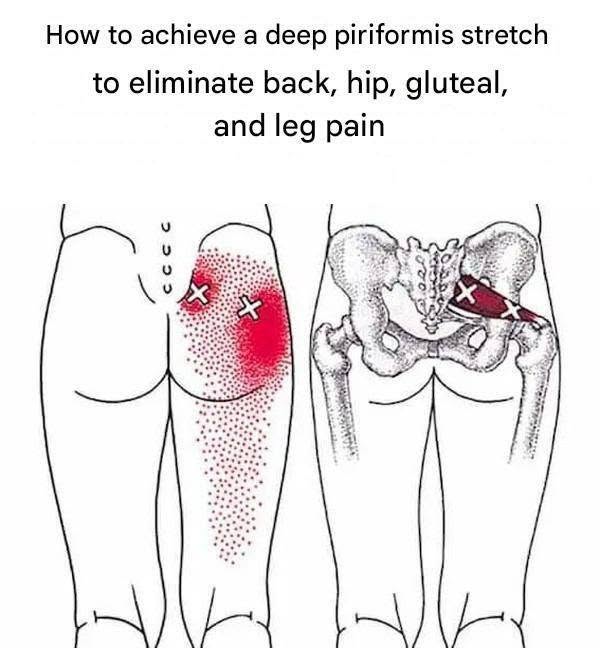
A tight piriformis muscle can contribute to pain in the buttock and, in some people, pain that radiates down the leg if it irritates the **sciatic nerve>. However, no stretch can guarantee elimination of back, hip, gluteal, or leg pain, because those symptoms can have many different causes.
Here are two commonly recommended piriformis stretches:
1. Figure-4 stretch (lying down)
- Lie on your back with both knees bent.
- Cross your right ankle over your left thigh, just above the knee.
- Reach behind your left thigh and gently pull it toward your chest.
- You should feel a stretch in the right buttock.
- Hold for 20–30 seconds, then repeat 2–4 times on each side.
2. Seated figure-4 stretch
- Sit in a sturdy chair.
- Place one ankle on the opposite knee, forming a “4” shape.
- Keeping your back straight, lean forward slightly until you feel a stretch in the buttock.
- Hold for 20–30 seconds and repeat on the other side.
Tips
- Stretch gently—you should feel tension, not sharp pain.
- Breathe normally and avoid bouncing.
- Perform the stretches consistently, such as once or twice a day if comfortable.
When stretching may not be appropriate
If your pain is caused by conditions such as Sciatica from a spinal problem, Hip Osteoarthritis, or another underlying condition, piriformis stretches may provide little benefit or could aggravate symptoms.
Seek medical evaluation promptly if you have:
- Severe or worsening pain
- Weakness in the leg
- Numbness that is increasing
- Loss of bladder or bowel control
- Fever, unexplained weight loss, or pain after a significant injury
If your pain is mainly in the lower back, buttock, outside of the hip, or down the leg, let me know where it starts and where it travels. That can help narrow down the most likely cause and the most appropriate exercises.