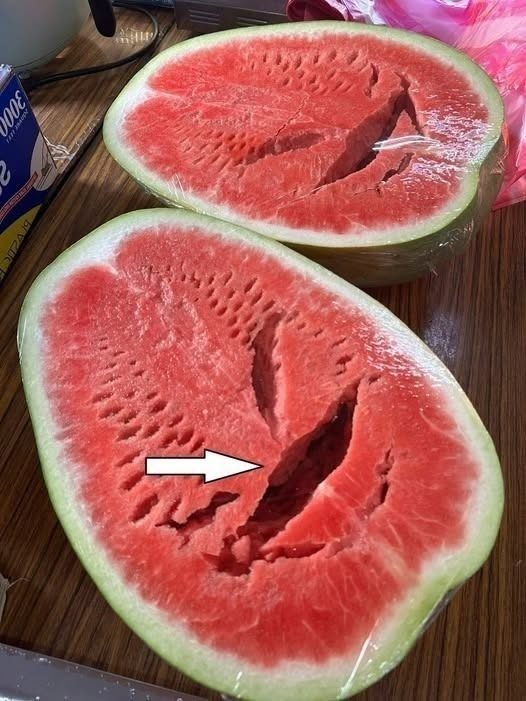
The claim “If you cut open a watermelon and see cracks, stop eating it immediately!” is misleading. Cracks inside a watermelon do not automatically mean it’s unsafe to eat.
Here are some common reasons you might see cracks or hollow areas:
- Natural growth: Rapid growth, uneven watering, or changes in temperature during development can cause the flesh to split internally. This is a common agricultural phenomenon.
- Overripeness: An overripe watermelon may develop cracks and have a softer, grainier texture.
- Pollination issues: Incomplete pollination can sometimes lead to internal defects, including hollow or cracked areas.
Is it safe to eat?
If the watermelon:
- Smells fresh and sweet,
- Has firm, brightly colored flesh,
- Has no mold or slimy areas,
- Doesn’t have an off or fermented odor,
then the cracked portions are usually safe to eat, although the texture may be less appealing.
When should you throw it away?
Discard the watermelon if you notice:
- Mold (white, green, black, or fuzzy growth)
- A sour, fermented, or alcoholic smell
- Slimy or mushy flesh
- Extensive discoloration or signs of decay
- It has been left at room temperature for more than about 2 hours after being cut (or 1 hour if the temperature is above 32°C/90°F)
Myth: Cracks Mean Chemical Injection
A common social media myth claims that cracks are proof the watermelon was injected with hormones or chemicals. There is no reliable evidence that internal cracking alone indicates this. Internal cracks are a well-recognized result of natural growing conditions and fruit development.
So, cracks by themselves are not a reason to stop eating a watermelon. Use your senses—look, smell, and texture—to judge freshness, and discard it if there are clear signs of spoilage.