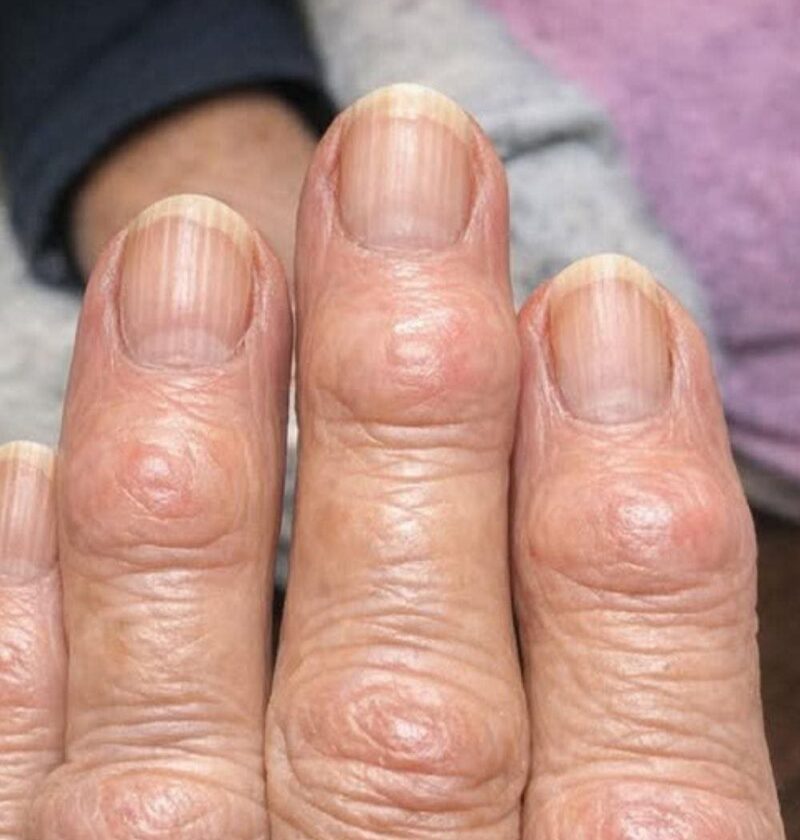
Hard bumps forming on the finger joints near the nails in an older adult are not something to assume is harmless or “just spreading aging changes.” There are a few common medical explanations, and the right one depends on how they look, how fast they’re changing, and whether there is pain or stiffness.
Here are the most likely causes:
1. Osteoarthritis “knuckle nodes” (most common)
This is the #1 possibility in older adults.
- Called Heberden’s nodes (near the nails, end joints)
- Or Bouchard’s nodes (middle finger joints)
These are bony enlargements caused by osteoarthritis.
Why it seems like it’s “spreading”
Osteoarthritis is a progressive wear-and-tear condition, so:
- One finger may be affected first
- Then others gradually develop similar bumps
- It can look like it’s “spreading,” but it’s really joint degeneration over time
Typical signs:
- Hard, bony lumps
- Slowly developing over months/years
- Mild stiffness, especially in the morning
- Sometimes deformity of fingers
2. Rheumatoid arthritis (inflammatory arthritis)
Less likely if the bumps are only at the nail joints, but important to rule out.
Signs that suggest this:
- Soft or firm swelling, not just hard bone
- Pain, warmth, or redness
- Morning stiffness lasting >30–60 minutes
- Multiple joints on both hands affected symmetrically
This is an autoimmune condition, and it can progress if untreated.
3. Mucous (ganglion) cysts near nails
These are fluid-filled bumps that can appear near finger joints.
Features:
- Round, smooth bump near nail
- May change size over time
- Can press on nail and distort it
- Usually not “hard bone-like”
They are benign but sometimes need drainage or removal.
4. Gouty tophi (less common but important)
If there is long-term high uric acid:
- Chalky or firm nodules can form
- Often near joints and fingers
- May be painful during flare-ups
5. Bony growths from aging or past joint injury
Old injuries or long-term stress on joints can cause:
- Localized hard lumps
- Gradual worsening over time
When it needs medical attention (important)
Your grandmother should be checked by a doctor if:
- The bumps are increasing quickly
- There is pain, redness, or warmth
- Fingers are becoming deformed
- She has difficulty using her hands
- Multiple joints are affected
A rheumatologist or orthopedic doctor can usually diagnose this with:
- Physical examination
- X-ray (for osteoarthritis changes)
- Blood tests (if inflammatory disease is suspected)
What you should NOT assume
- It is usually not contagious or spreading from person to person
- It is not typically an infection if it’s slow and hard
- It is not something vinegar, oils, or home remedies can reverse
Simple reality
In most older adults, this pattern is most consistent with osteoarthritis-related knuckle changes, which progress slowly over time and can appear on multiple fingers.