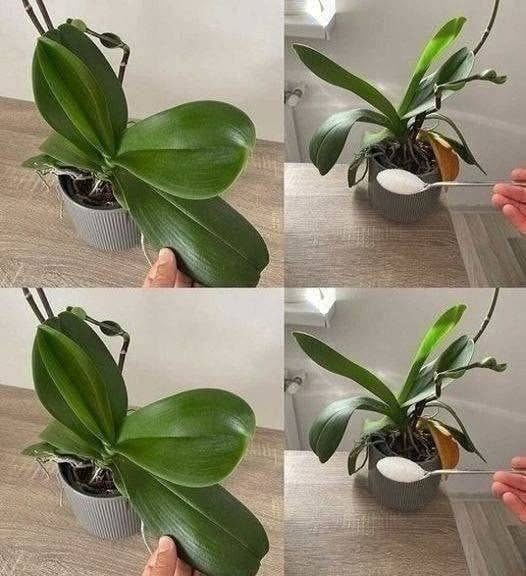
That “one tablespoon and orchids will bloom forever” claim is another social media exaggeration.
Orchids don’t work like that. There is no single magic fertilizer dose that guarantees continuous blooming.
What does help orchids (especially Orchidaceae) is a balanced, consistent care routine, not a one-time strong feeding.
Why the “1 tablespoon trick” is misleading
- Too much fertilizer can actually burn orchid roots
- Orchids absorb nutrients very slowly compared to other plants
- Overfeeding often leads to leaves growing instead of flowers
- Blooming depends more on light + temperature + rest cycles than fertilizer alone
What orchids really need to bloom
Healthy flowering usually depends on:
1. Light (most important factor)
Bright, indirect light is key. Too little light = no flowers.
2. Proper watering
Water only when the roots look silvery/gray, not on a fixed daily schedule.
3. Mild fertilizer (not heavy doses)
Instead of a “tablespoon boost,” orchid growers usually use:
- Weak fertilizer (¼ strength)
- Applied every 2–4 weeks during active growth
4. Rest period
Many orchids need a cooler or slightly drier rest phase to trigger new blooms.
The truth in simple terms
- Fertilizer helps growth, not “instant blooming”
- More fertilizer ≠ more flowers
- Consistency beats intensity
Bottom line
If someone promises “continuous blooming with one spoon,” it’s marketing, not horticulture.
If you want, tell me what type of orchid you have and I can give you a simple bloom-restart plan tailored to it.